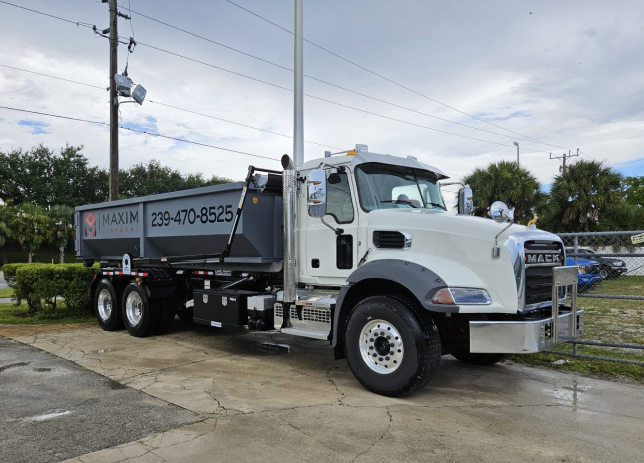
Concrete Disposal Dumpster Rental
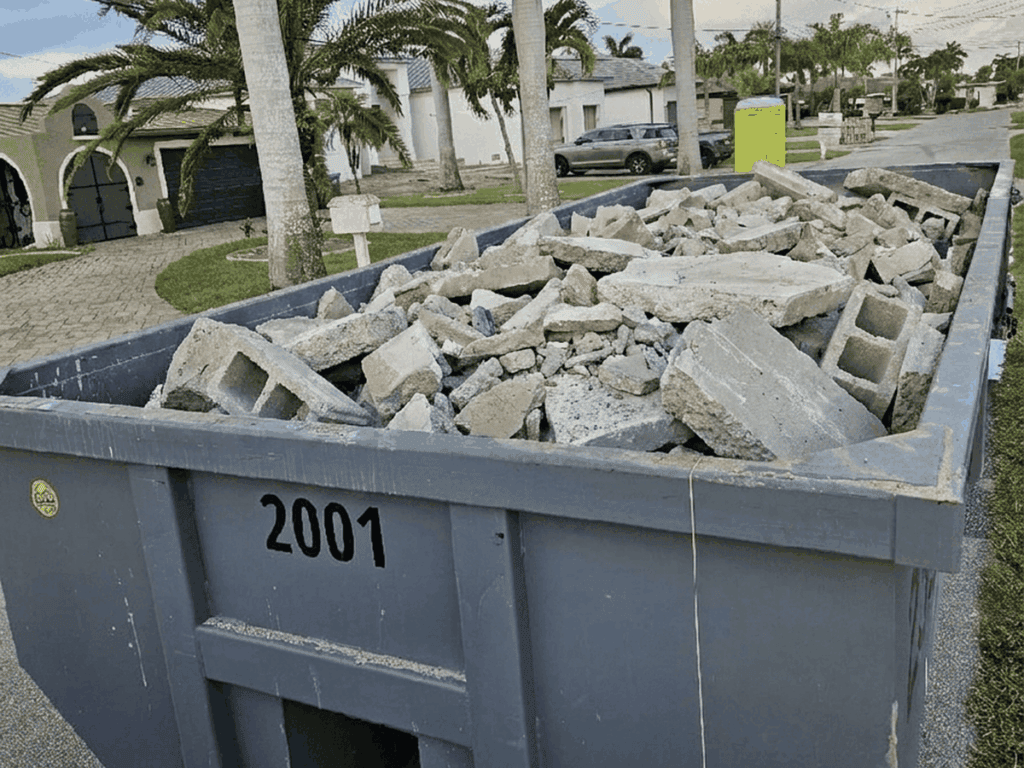
Clean Concrete and Block
Maxim Disposal runs a dedicated concrete container across Southwest Florida — driveway and slab tear-outs, sidewalk, patio, footers, block, curb and busted flatwork. For contractors, concrete crews and homeowners taking out flatwork.
Clean concrete is the cheapest material you can dispose of down here, because it goes to a recycling facility instead of a landfill. Call and we will tell you what it costs and when we can be there, on that call.
Why Concrete Is Priced Differently
Concrete is priced on weight, not volume. A 20 yard can of broken slab hits its limit long before it looks full — which is why the concrete can is a different product from a 20 yard for mixed debris, even though it is the same container.
The 20 Yard Concrete Can
Our dedicated concrete can is a 20 yard with a 15-ton limit, at the same rate as a 20 yard for mixed construction debris. Fifteen tons is roughly 5 to 6 inches of slab across a two-car driveway.
Do not expect to fill it to the rail. A properly loaded concrete can sits low — the weight is gone long before the volume is.
Keeping the Load Clean
Clean means concrete, block and brick only. No wood, no plastic, no metal, no dirt, no vegetation, no trash.
Rebar is fine, but it adds $100 to the load.
Here is the part worth understanding. A little contamination is at the scale operator’s discretion, and they are not always consistent about what counts as moderate versus excessive. Keep it as clean as you can. Moderately contaminated concrete is $250. If a load gets reclassified as C&D we are charged the C&D rate and we have to pass that through — $79 per ton.
The difference between a clean load and a sloppy one is real money. It is worth ten minutes of sorting.
01
Request a Quote and Delivery
Call (239) 470-8525 and tell us what is coming out — driveway, patio, footers, block wall — roughly how many square feet and how thick. That is enough for us to size it. Same-day is often on the table, next day is routine.
Prepare, Place, and Load Your Dumpster
Pick the drop spot and clear it. Concrete cans ride heavy, so the surface matters more than usual — we will tell you if a spot looks like a problem. Load it flat and spread across the floor of the can rather than piled at one end.
02
03
Arrange Pickup and Disposal
Call when you are ready and we haul it to the recycling facility, where it gets crushed for road base. Your rate covers 30 days, delivery, pickup, disposal and all applicable taxes. The only thing added to every rental is a $30 flat fuel fee, charged once per load — not a percentage that grows with your invoice.
Communities We Serve
We run 26 markets across Southwest Florida, from Marco Island north to Sarasota. Island and barrier destinations — Sanibel, Captiva, Marco Island, Pine Island and Boca Grande — carry a destination fee for bridge access and drive time. Everything else, including the long inland and northern runs, is standard rate.
Coverage Service Areas
Doing demo that produces both concrete and mixed debris? Run two cans. Keeping the concrete separate almost always costs less than one mixed load — see construction debris, or call (239) 470-8525 and we will work out which way is cheaper for your job. Rates and the full fee schedule are here.
Frequently Asked Questions About Concrete Disposal
What people ask before a slab comes out.
Concrete, block and brick, and nothing else. No wood, plastic, metal, dirt, roots or trash. Rebar is acceptable but adds $100. A clean load goes to a recycling facility at the concrete rate; a contaminated one gets reclassified as construction debris at $79 per ton and we have to pass that cost through.
The limit is weight, not volume — 15 tons. That is roughly 5 to 6 inches of slab across a two-car driveway. The can will look far from full when it is at limit, and that is normal. If you are not sure, call (239) 470-8525 with the square footage and thickness and we will do the math with you.
Substantially, and it is the single biggest cost lever on a demo job. Clean concrete is recycled into road base rather than landfilled, and it is the cheapest material we haul. The moment wood or plastic goes in with it, that advantage is gone and the whole load prices as construction debris.
Concrete, block, brick, sidewalk, slab and curb with no wood, plastic, drywall, roofing or dirt mixed in. The scale house makes the call, not us, and whatever they charge gets passed through — so cleaner is always cheaper. Rebar is fine and adds $100.
Because clean concrete goes to a recycling facility that crushes it for road base instead of to a landfill. The disposal cost is completely different, which is why a 20 yard concrete can is the same $425 but carries 15 tons.
Fill it up but keep it below the rail. Loaded that way a concrete can comes in right around 15 tons, which is where the limit is set. Filled to the tip top and packed tight it can pass 20 tons, and at that point we will ask for some of it to come off before we haul it.
You can, but you pay the worse of the two. A mixed load is priced as construction and demolition debris, and concrete is heavy — at $79 a ton over the allowance that adds up fast. A few chunks will not hurt. A slab’s worth belongs in a concrete can.